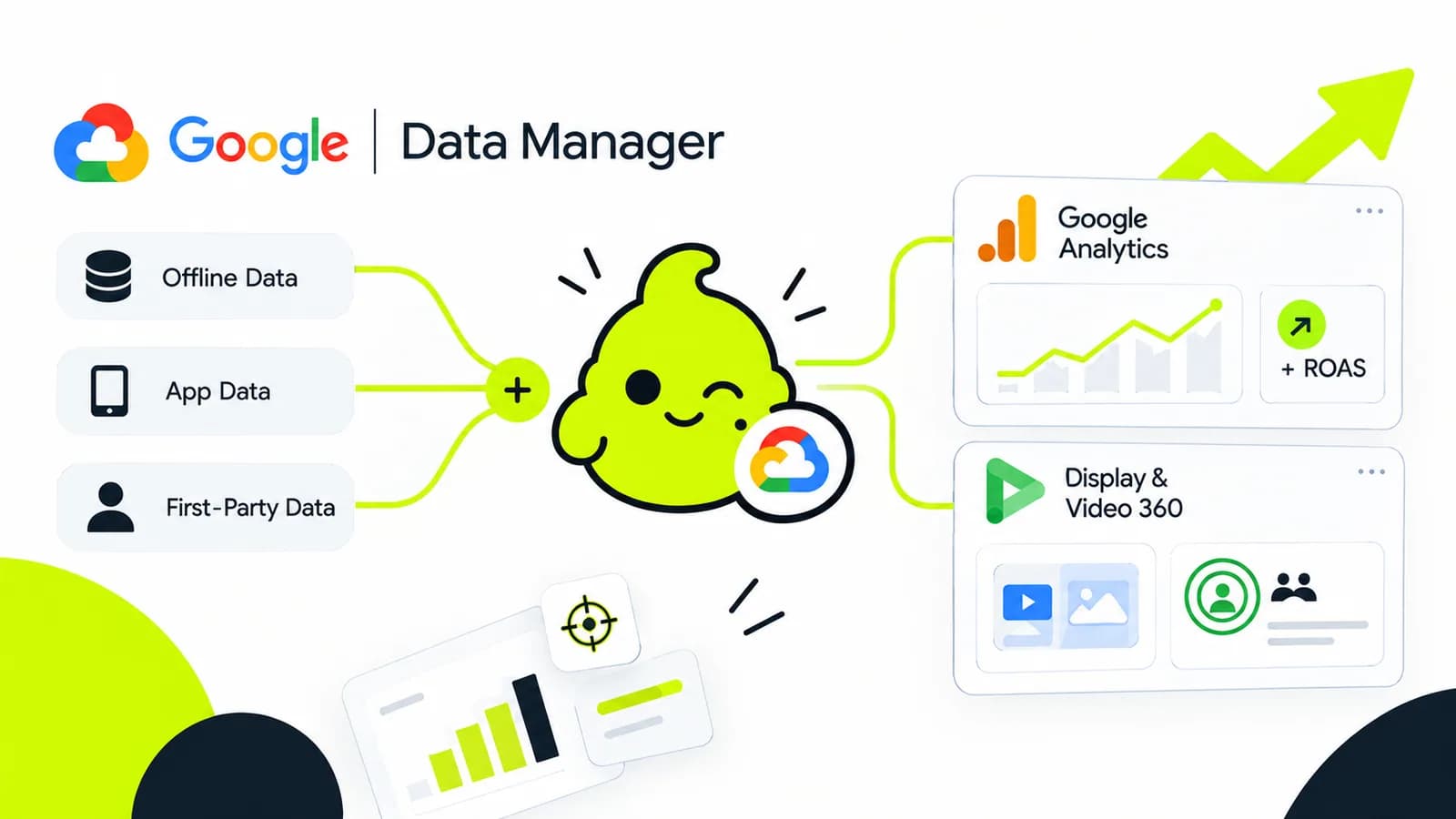
Google has rolled out significant Google Data Manager updates, adding new AI-powered agentic capabilities and expanding integration tools across Google Analytics and Display & Video 360. These updates allow advertisers to seamlessly connect offline and first-party app data to ad platforms, providing more accurate targeting and measurable increases in Return on Ad Spend (ROAS).
The Evolution of First-Party Data Integration
Google Data Manager serves as a centralized hub where advertisers can securely upload their owned customer and sales data to directly inform and improve their Google ads targeting.
For years, marketing teams have struggled with siloed data. You have valuable customer insights sitting in your CRM, offline sales records in a separate database, and app activity logged somewhere else entirely. Translating that scattered, first-party data into actionable advertising campaigns has historically required complex engineering workarounds.
Google is actively trying to eliminate that friction. The Google Data Manager platform acts as a secure, centralized portal. It allows advertisers to upload their owned customer data directly into the Google ecosystem. The overarching goal is to feed the algorithm with actual conversion insights rather than relying solely on third-party cookies or platform estimations.
The latest round of Google Data Manager updates is specifically designed to expand how this first-party data can be utilized, giving AI targeting tools a much clearer picture of who your actual buyers are. When you feed the machine high-quality data, the machine returns high-quality leads.
Recent industry data shows that 85% of marketers are now prioritizing first-party data collection strategies in Q3 2026, driven primarily by evolving privacy regulations and the continued deprecation of third-party cookies.
Expanding Connections: Analytics and DV360
The new update seamlessly integrates Data Manager info into Google Analytics and Display & Video 360, driving a reported 26% average increase in incremental ROAS for advertisers connecting offline and app data.
The most immediately impactful feature of this rollout is the expanded integration capability. Google has officially launched a pipeline that feeds Data Manager information directly into both Google Analytics and Display & Video 360 (DV360).
This is a massive operational win for performance marketers. By expanding the data sourcing, advertisers gain enhanced audience insights and significantly more accurate display options. You are no longer guessing which audience segment performed best; the offline and app data validates it.
The performance improvements are not theoretical. According to Google, advertisers who connect their offline and app data to the Data Manager are seeing an average 26% increase in incremental Return on Ad Spend (ROAS). Furthermore, Google is rolling out enhanced conversions across these platforms, providing another layer of accuracy for matching customer data securely and optimizing campaign delivery.
AI Agentic Capabilities and the Meridian Portal
Google is introducing AI-powered agentic features into the Meridian data portal to automatically audit data quality, resolve errors in real-time, and guide Marketing Mix Modeling.
Beyond simple connections, Google is bringing autonomous intelligence to data management. They have significantly updated their Meridian data portal, which utilizes Marketing Mix Modeling to measure overall ad impact.
The major headline here is the introduction of AI-powered agentic capabilities directly into Meridian. Instead of a data analyst spending hours hunting for discrepancies or formatting issues, these AI agents are designed to audit data quality autonomously. They can resolve errors and guide model building in real-time, ensuring the data feeding your campaigns is clean and actionable.
Additionally, Google expanded the connective options in the Data Manager API based on the IAB Tech Lab's Event and Conversions API (ECAPI) standard. This provides a unified, secure setup to activate audiences across major platforms, complete with new built-in diagnostics that flag data issues before they negatively impact your live campaigns.
The latest Google Data Manager updates represent a critical shift in how advertisers must approach targeting. As the digital landscape moves further away from third-party tracking, the ability to seamlessly and accurately deploy your owned, first-party data is the only reliable path to sustained ROAS. Marketers must prioritize cleaning their internal databases and fully integrating them with these new AI-powered tools to ensure their campaigns remain competitive.
FAQs
What is Google Data Manager?
Google Data Manager is a centralized, secure platform that allows advertisers to upload, manage, and activate their first-party data (like CRM lists, offline sales, and app data) to improve targeting and measurement across Google's advertising ecosystem.
How do the new Google Data Manager updates improve ROAS?
By integrating offline and app data directly into Google Analytics and Display & Video 360, advertisers can better guide AI-powered targeting tools with actual conversion insights. Google reports this leads to an average 26% increase in incremental ROAS.
What is the Meridian data portal in Google?
Meridian is Google's open-source Marketing Mix Modeling (MMM) portal designed to help advertisers measure the holistic impact of their marketing campaigns. Recent updates added AI-agentic capabilities to automatically audit data quality within the portal.
What does the Data Strength Uplift Metric do?
Launched in Google Ads alongside the Data Manager updates, the Data Strength Uplift Metric calculates the additional conversions that are specifically attributed to the integration of first-party data sources, allowing marketers to clearly quantify the impact of their data.