
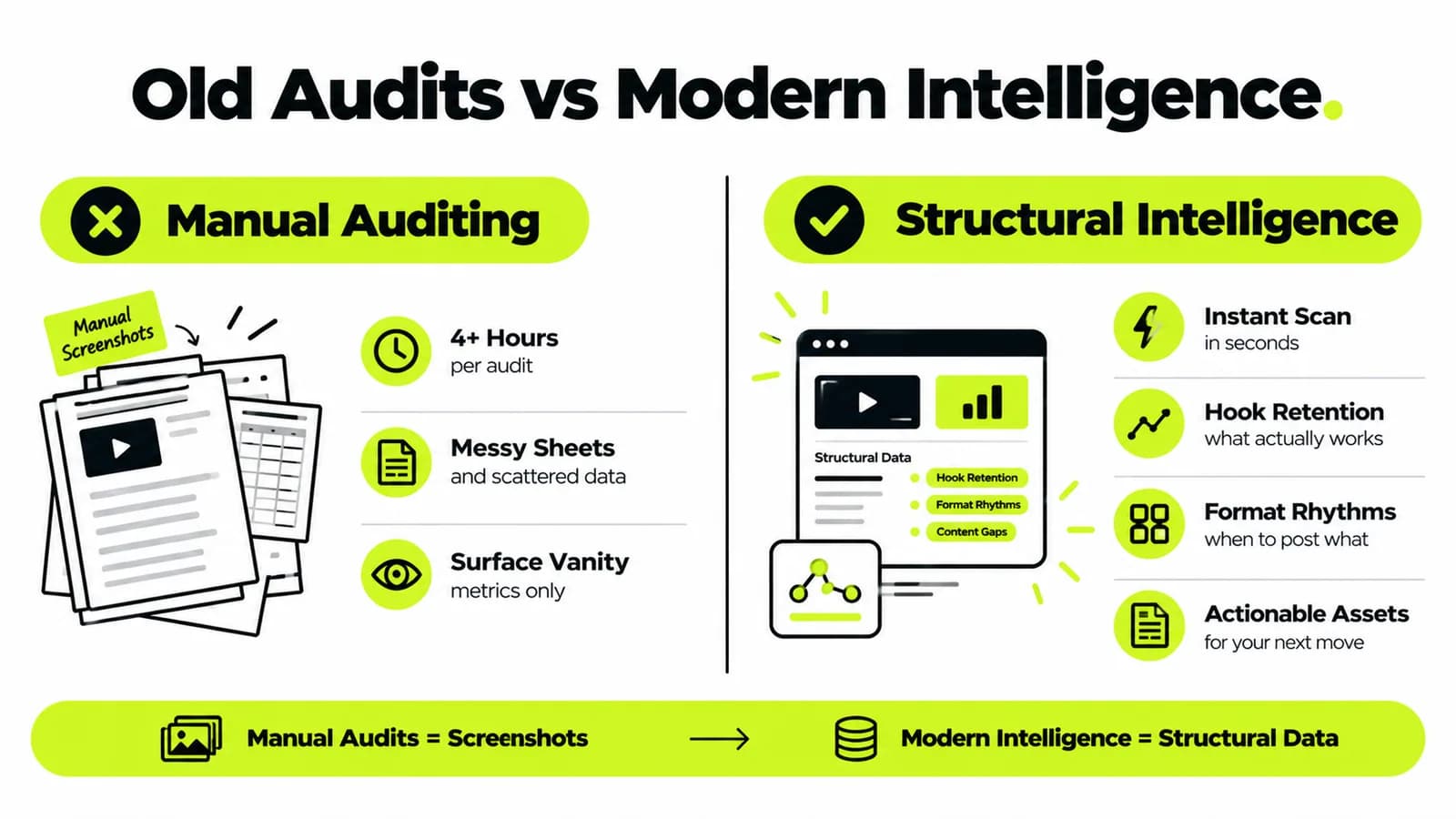
Running an effective social media competitor analysis does not mean spending hours manually taking screenshots and pasting engagement rates into broken spreadsheets. Modern competitive intelligence focuses on four structural mechanics: hook hooks, format rhythm, posting cadence, and pillar allocation. By breaking down how your rivals actually build their posts, you can pinpoint audience fatigue and counter with better creative in minutes. Here is the exact step-by-step workflow smart marketing teams use to out-publish their competition.
What is a Social Media Competitor Analysis (and Why Most Marketers Do It Wrong)?
A social media competitor analysis is the structured evaluation of your competitors' content strategy, publishing patterns, creative formats, and audience sentiment across social channels. It reveals exactly what hooks, themes, and creative assets resonate with your shared target market so you can build higher-converting campaigns without guessing.
Let us be completely honest about how most teams handle this task today. Someone opens Instagram, TikTok, and LinkedIn, scrolls for four hours under the guise of "research," and dumps thirty random screenshots into a shared Slack channel. By Friday, that research is buried under a mountain of client requests and unread memes.
This is not an isolated workflow. In a 2026 study of SaaS product-marketing teams, 68% said their primary source of competitive intelligence was manual website checks and team-contributed Slack screenshots, while only 23% of SaaS companies with 50–500 employees used a dedicated competitive-intelligence platform. In other words, spreadsheets, screenshot folders, and scattered Slack threads remain the default competitive-research stack for many teams.
The fatal flaw in traditional competitive audits is mistaking vanity metrics for strategy. Tracking total follower counts or surface-level likes tells you almost nothing about why a specific reel stopped the scroll or how an account generated three hundred qualified leads. Real competitive intelligence is not about copying a rival's feed, it is about understanding their underlying creative architecture.
When you analyze how a competitor structures their hooks, switches between formats, and maintains audience retention, you stop playing catch-up. You begin to spot structural vulnerabilities, such as stagnant content formats or ignored customer pain points, that your brand can exploit immediately.
The 4 Structural Pillars You Actually Need to Track
The four core pillars of competitive analysis are hook opening rate, format rhythm, posting cadence, and content pillar distribution. Measuring these distinct operational drivers reveals why top-performing posts work, rather than simply recording that they gained impressions.
Most legacy reporting tools overload you with vanity numbers that do not lead to creative decisions. To build campaigns that actually steal attention, you only need to diagnose four structural levers across your competitors' feeds.
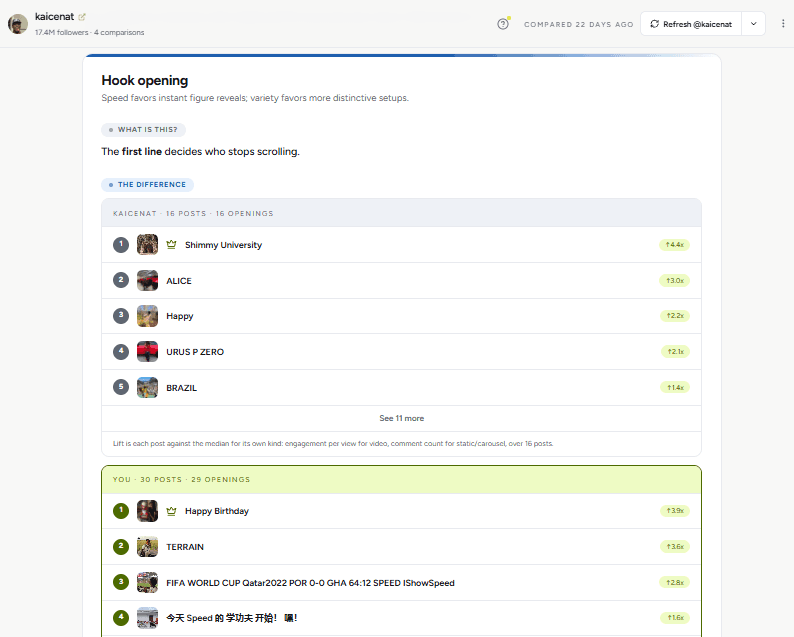
1. Hook Opening Dynamics
The first three seconds of a short-form video or the opening line of a carousel determine 90% of your post's success. When dissecting a competitor, analyze the precise mechanics of their top-performing hooks. Do they lead with a controversial contrarian statement, a quantifiable data point, or an immediate problem-agitation frame?
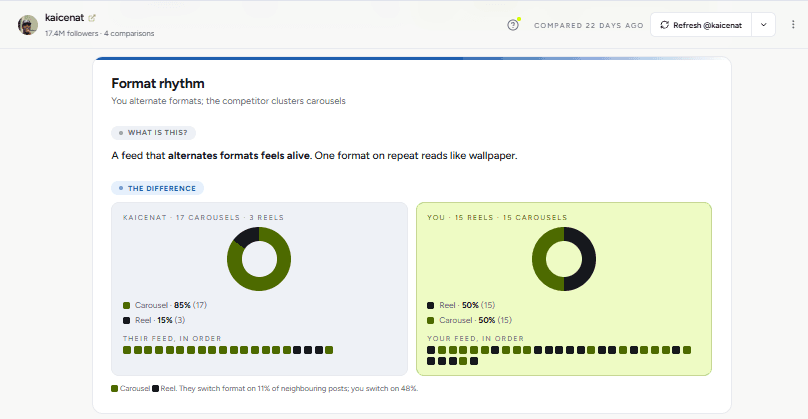
2. Format Rhythm
Audiences get bored when an account serves the exact same dish every single day. Examine your competitor's format rhythm, which is the frequency and pattern with which they switch between Reels, carousels, and single-image graphics. High-growth brands maintain healthy format variety to avoid algorithmic fatigue and keep followers actively tapping through their carousels.
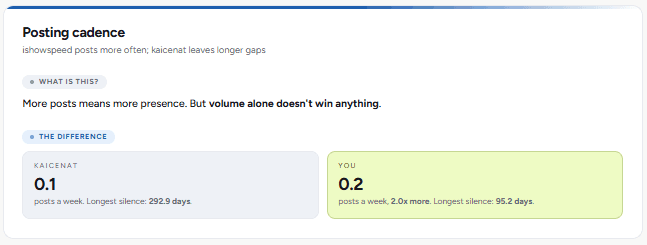
3. Posting Cadence and Silence Gaps
Consistency is more than just publishing three times a week. You need to map out your rival's longest gaps of silence and identify the exact days their engagement peaks. If your chief competitor always goes quiet on Thursday afternoons, that represents open prime real estate for your brand to dominate the feed.
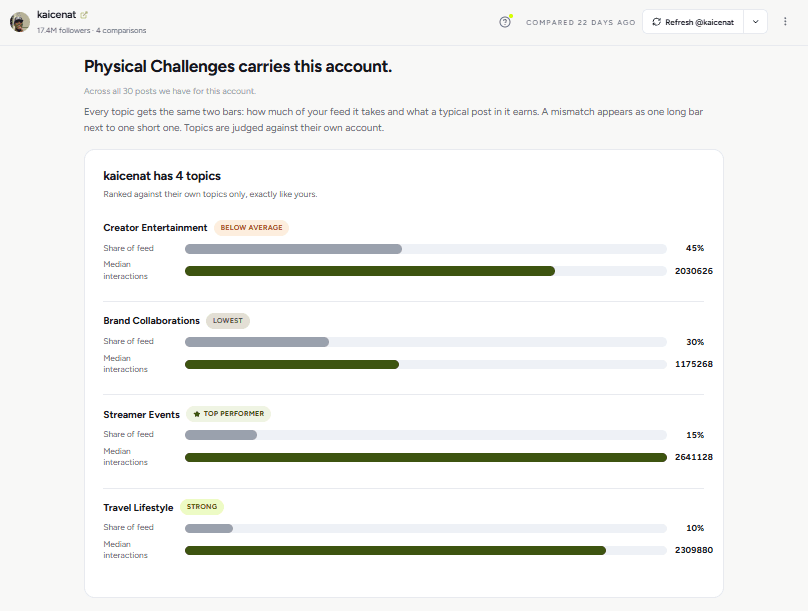
4. Content Pillar Distribution
Every sustainable social strategy relies on distinct content pillars, such as product education, thought leadership, customer proof, or relatable entertainment. Calculate the percentage of feed space your competitor allocates to each topic versus the actual engagement that topic generates. When you spot a pillar that gets massive interaction despite low posting frequency, you have found an underserved content goldmine.
How to Do a Social Media Competitor Analysis: Step-by-Step Workflow
To execute a social media competitor analysis, identify three direct and indirect rivals, audit their last thirty posts, benchmark structural creative metrics, and identify critical audience gaps. Automating this data aggregation prevents team burnout and eliminates spreadsheet chaos.
Following a repeatable workflow ensures you spend your working hours building high-impact assets rather than wrestling with manual data entry. Here is the four-step framework you can roll out right now.
Marketing teams using AI-powered social media automation save an average of 5.1 hours per week per social media manager, including 2.2 hours per week on performance reporting.
Step 1: Identify Your Direct, Indirect, and Aspirational Rivals
Start by selecting three distinct types of competitors to benchmark. Direct competitors sell the exact same solution to your audience, while indirect competitors target the same audience with an alternative offer. Aspirational competitors are brands outside your direct space that execute social storytelling at an elite level.
Limiting your initial audit to three or four focused accounts keeps your analysis sharp and actionable. Tracking thirty accounts simultaneously will only cause decision paralysis and obscure your core takeaways.
Step 2: Extract the Last 30 Posts for Pattern Recognition
Never evaluate an account based on their top three pinned posts or yesterday's viral fluke. You need a representative sample size, specifically the last thirty consecutive posts, to observe true strategic habits.
Reviewing thirty posts allows you to spot actual algorithmic consistency, average comment ratios, and baseline engagement rates. If you attempt this manually, you will end up building massive spreadsheets with dozens of manual formulas. Automated tools can scrape and organize these thirty posts in a matter of seconds.
Step 3: Grade Their Creative and Profile Clarity
Run your competitors through a rigorous diagnostic check. Evaluate their profile clarity, including whether their bio delivers an immediate follow-promise and whether their display name targets searchable industry terms.
Next, inspect their creative formats. Are they using carousels when educational slides would communicate the idea far more clearly? If their engagement rate dips below industry benchmarks, note the format mismatch so your team can avoid the same pitfall.
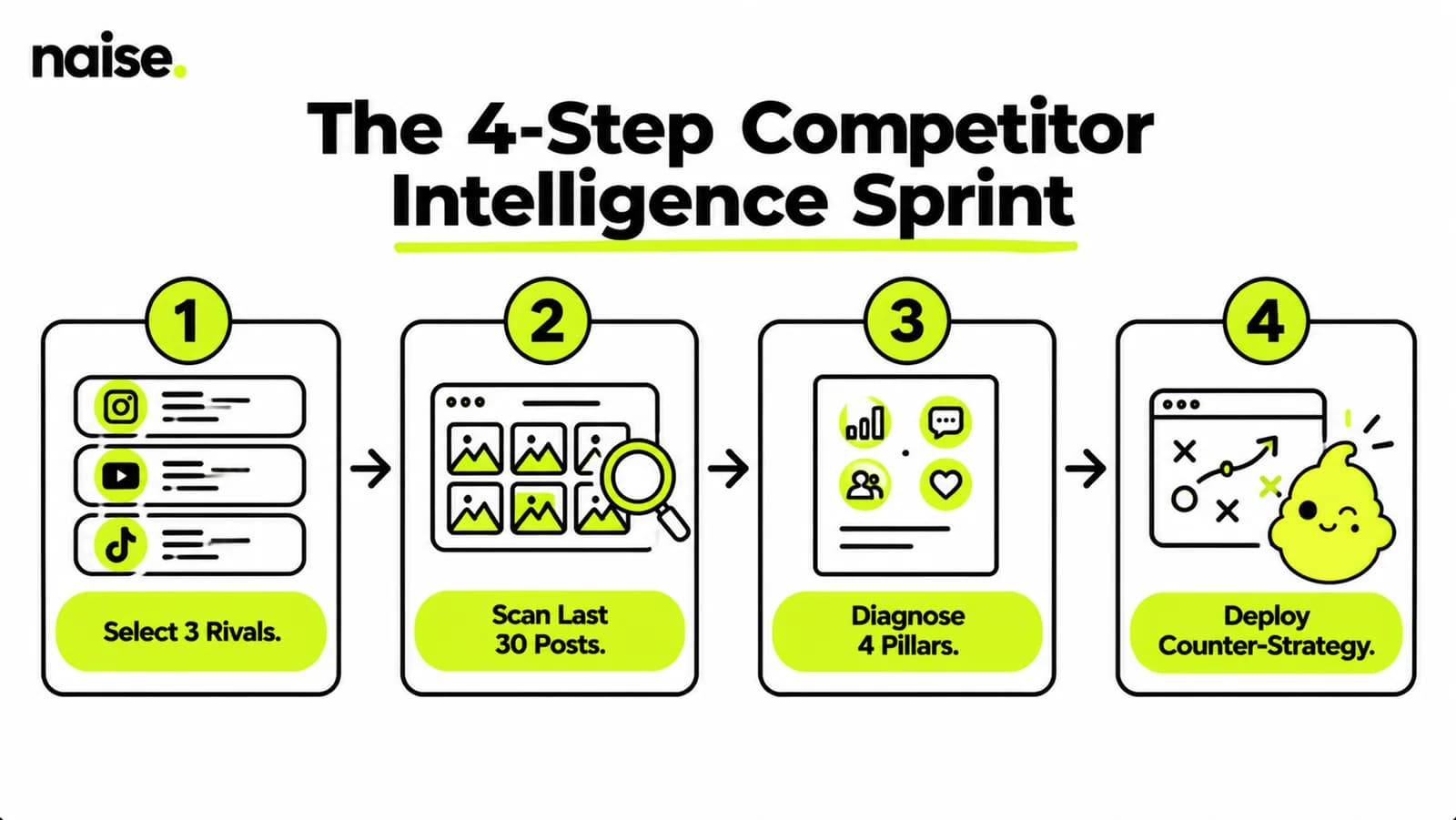
Step 4: Map the "Share of Feed" Against Audience Engagement
Create a simple quadrant mapping your rival's topics. On one axis, measure their "Share of Feed," which represents how often they talk about a specific subject. On the other axis, measure their "Median Interactions," showing how the audience actually responds.
Whenever you find a topic with high interactions but low feed share, you have uncovered a massive opportunity. That gap tells you that the market is craving specific answers that your competitor is too slow or too lazy to produce consistently.
Turning Competitor Intelligence into Content You Can Publish Today
Transforming competitive analysis into published assets requires mapping rival weaknesses directly into your live editorial calendar. Modern marketing teams use integrated platforms to translate diagnostic findings into fully formatted captions, image assets, and scheduled campaigns without leaving the workflow.
Data that sits trapped inside a spreadsheet never helped a single brand grow. The real magic happens when your competitive discoveries instantly fuel your daily creative production.
This is where the traditional marketing stack completely breaks down. Usually, you conduct research in one tool, paste notes into a document, write prompts in ChatGPT, and then export drafts into a separate scheduling app. By the time you draft the first asset, your competitive insight is already stale.
Instead of navigating that fragmented setup, you can consolidate the entire pipeline inside Naise AI. From The Dashboard, you run an instant diagnostic on any competitor profile using our Social Audit engine. The system evaluates their last thirty posts, benchmarks their hook opening rate, compares their format rhythm, and surfaces their hidden topic gaps.

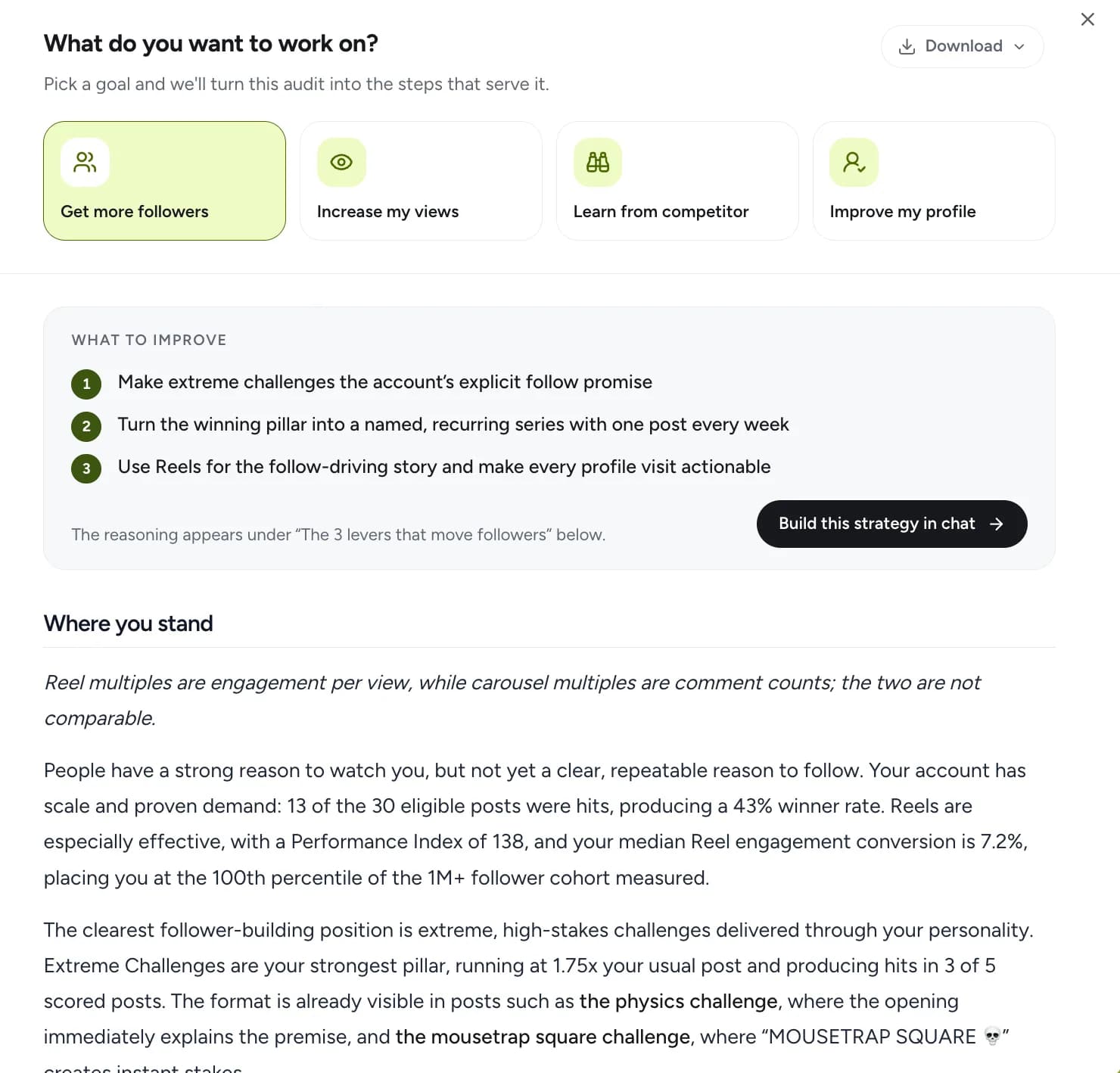
Once you spot an exploitable gap, you do not have to spend hours writing new briefs from scratch. With a single click on "Build this strategy in chat," the entire audit context transfers directly into your dedicated workspace.
Your saved brand identity and tone of voice stay locked in through Projects, while pre-engineered prompt workflows inside Playbooks guide the strategy. From there, the Social Media Agent takes over execution, drafting high-converting carousel copy, generating on-brand visual concepts, and preparing posts for publishing.
You go from auditing a competitor's feed to scheduling an entire counter-offensive campaign before lunch. That is how modern marketing teams protect their margins, eliminate prompt fatigue, and clock out on time.
Conclusion
A thorough social media competitor analysis is not about copying what the brand next door is doing. It is about understanding the structural mechanics of attention, finding where your rivals leave their audience hanging, and delivering the exact content your market wants.
Stop wasting entire afternoons scrolling through competitor feeds and wrestling with manual spreadsheets. Let our intelligent operators handle the heavy data crunching so you can focus on building winning campaigns.
Audit Your Competitors for Free
FAQs
How often should you conduct a social media competitor analysis?
You should conduct a comprehensive social media competitor analysis once every quarter to review macro trends and strategy shifts. However, tracking micro adjustments in competitor formats, hooks, and breakout content should be done on a monthly or bi-weekly basis to catch trending formats before they saturate the market.
What tools are best for social media competitor analysis?
While traditional tools like Sprout Social and Hootsuite offer legacy data tracking, modern platforms like Naise AI automate both the diagnosis and execution phases. Naise AI benchmarks structural metrics like hook strength and format cadence, then deploys autonomous agents to create counter-content immediately.
What metrics matter most when auditing competitor social accounts?
The most critical metrics are engagement rate, hook opening rate, format rhythm, and the ratio of content pillar distribution to audience interactions. Vanity metrics like total follower counts are easily manipulated and provide little insight into actual creative effectiveness or lead conversion.
How do you find content gaps during a competitor analysis?
You find content gaps by comparing a competitor's "Share of Feed" against their "Median Interactions." When a specific topic generates exceptionally high comments and shares despite only being posted occasionally, you have found an underserved market gap that your brand can claim.