The Illusion of Headcount in Rapid Business Scaling
Adding more people to a broken system does not equal faster growth; it just creates more administrative overhead and miscommunication.
When weekend reading materials highlight inspiring stories of rapid business scaling, they often skip the messy operational details. You read about massive revenue leaps and viral campaigns. You rarely read about the exhausted marketing manager manually formatting content across ten different platforms on a Sunday night.
The immediate reflex for a stressed founder is to hire another junior marketer. This seems like the logical path to scale marketing without hiring massive agencies. However, an extra set of hands does not fix a fundamentally broken daily workflow.
When you add new hires to a disjointed system, you spend weeks training them on your brand voice. You then spend hours approving their drafts in Google Docs, checking their scheduling in Hootsuite, and correcting their image choices in Canva. The cycle of manual oversight continues, keeping you trapped in the weeds instead of focusing on high-level marketing strategy.
Why the Fragmented Stack is Killing Your Growth Velocity
Relying on multiple disconnected tools forces marketers into endless context-switching, draining hours of productive time every single week.
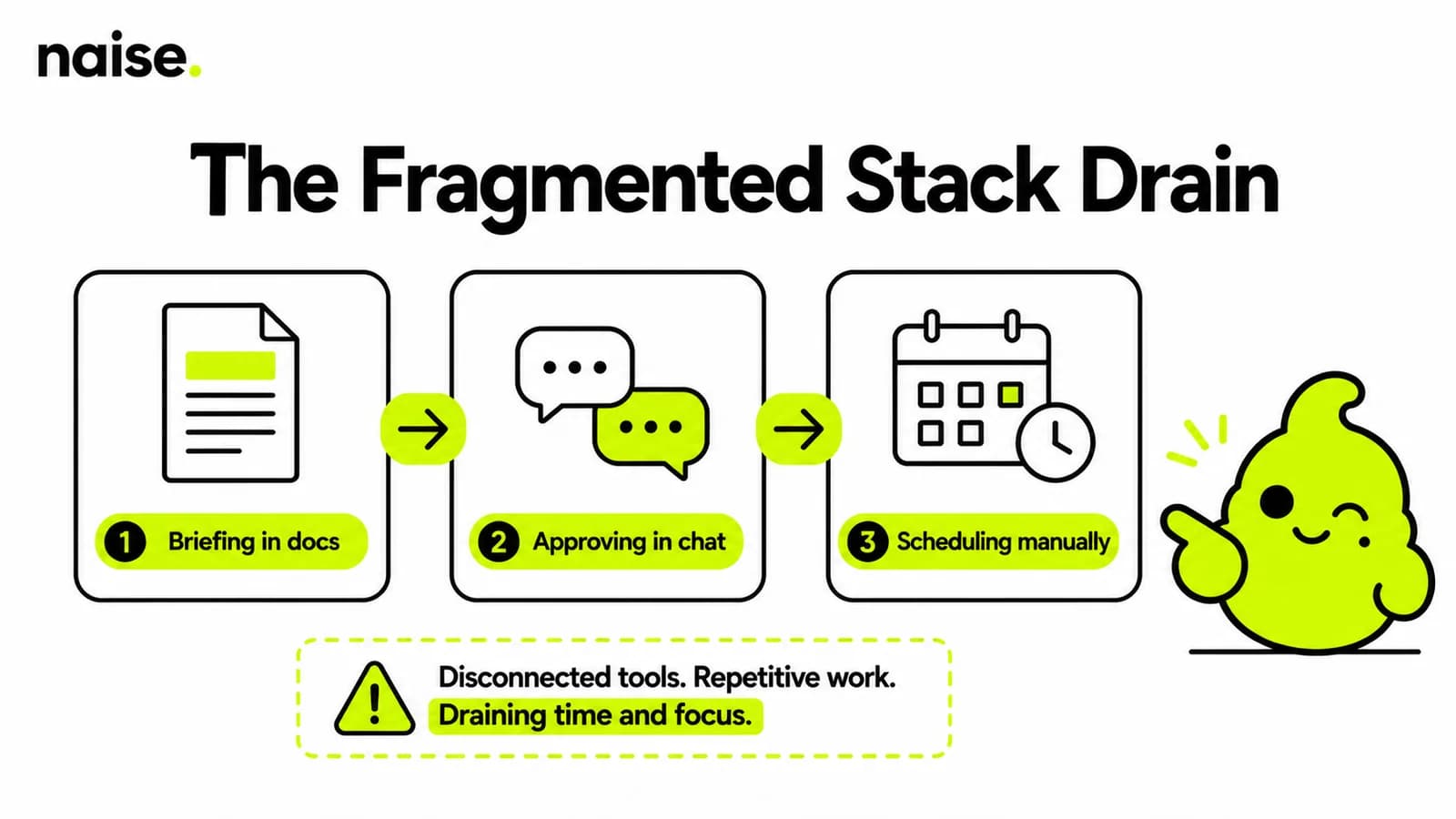
Take a hard look at how your team operates right now. You probably brief campaigns in Asana, draft copy in Notion, and argue over approvals in Slack. Once approved, someone has to physically move that text into Buffer or Sprout Social.
This is the Fragmented Stack. It forces highly paid creatives to act as human bridges between software tools that refuse to talk to each other. Every time a team member copies and pastes data from one window to another, your company leaks money.
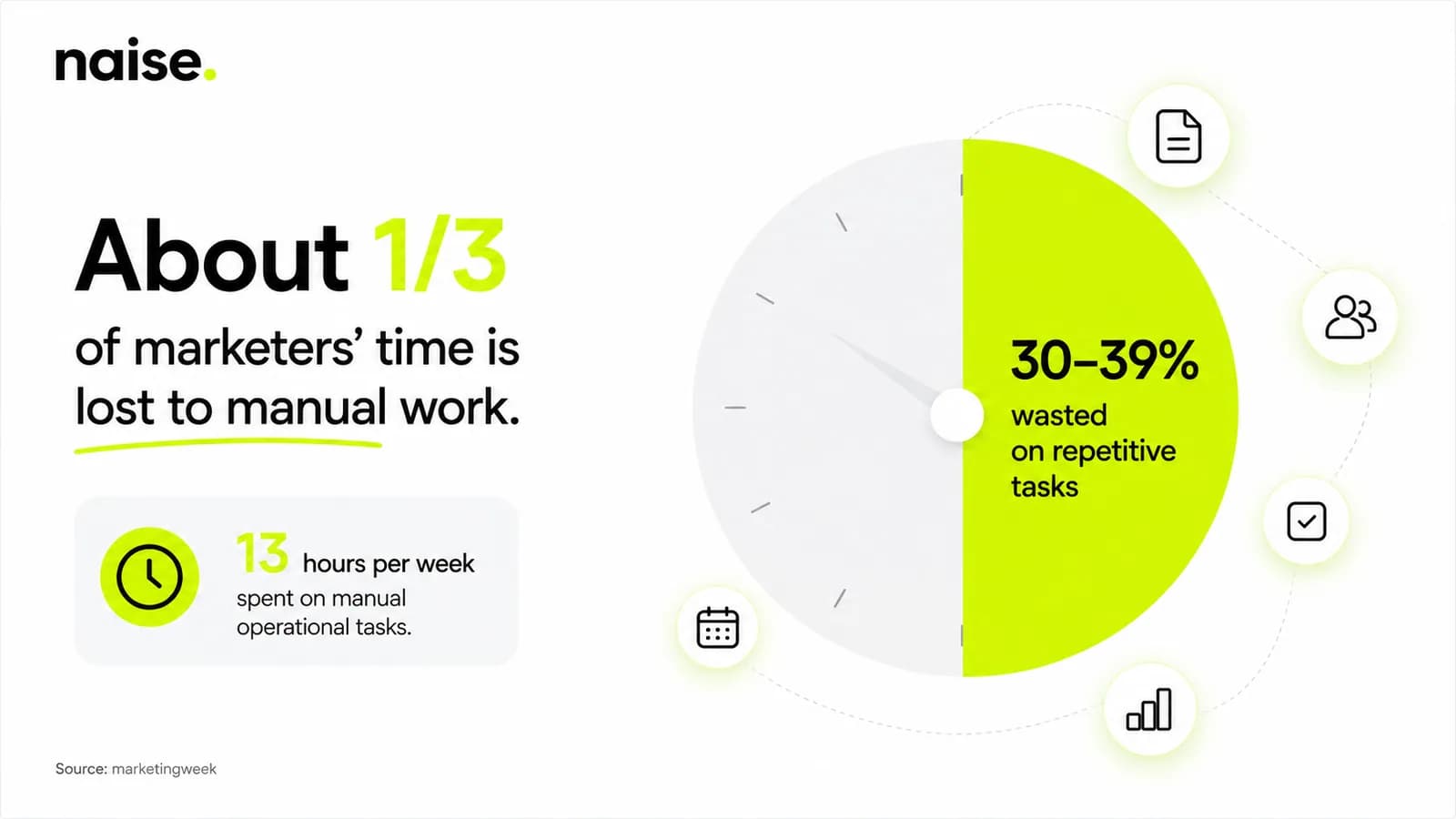
Marketers spend an average of 3.55 hours per week collecting, organizing, and analyzing data from separate sources, a measurable cost of fragmented marketing software and context switching.
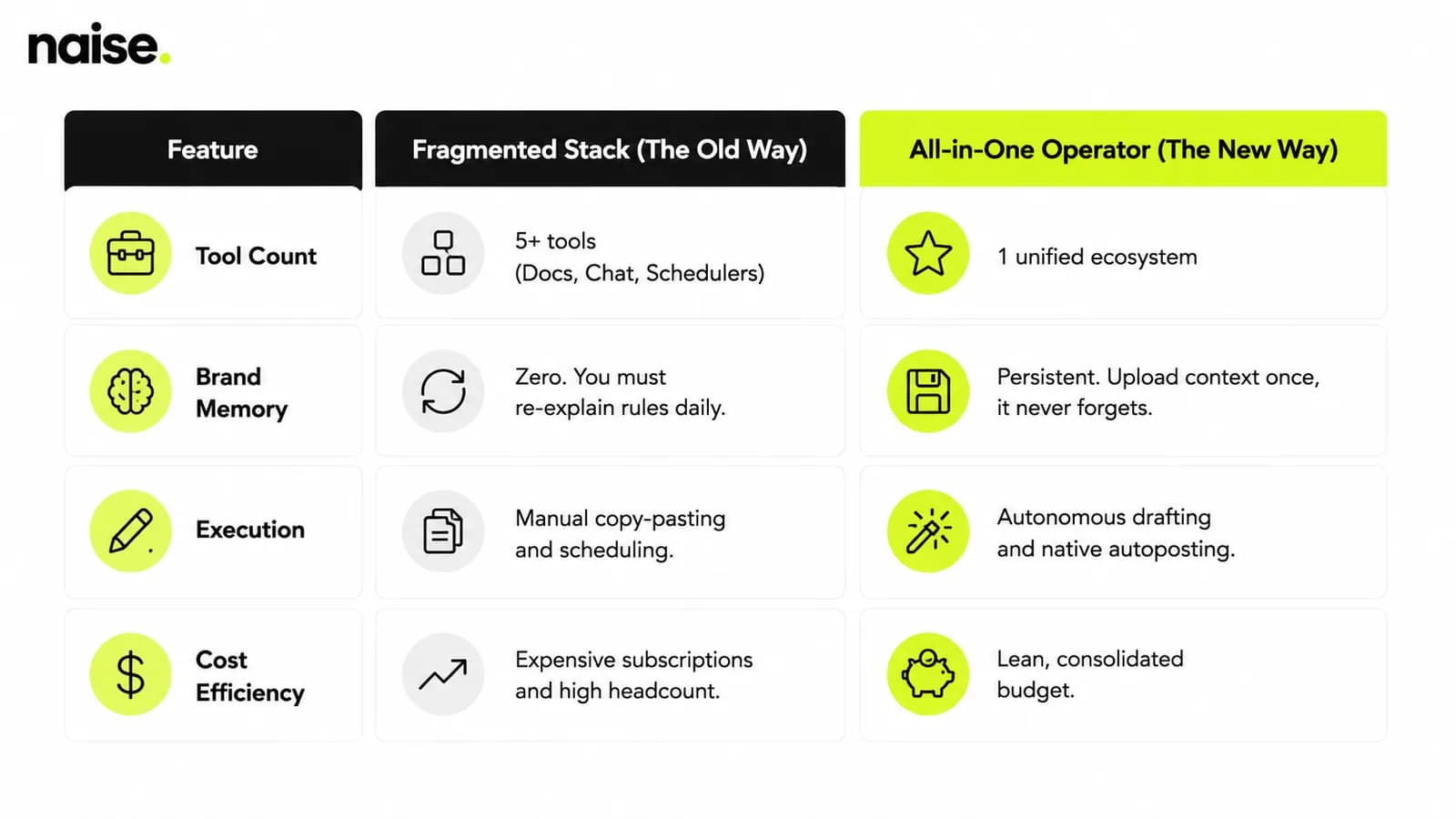
Beyond the lost time, this fragmentation causes massive Prompt Fatigue. If you use a generic AI text generator, you have to re-explain your brand tone, target audience, and product details every single morning. Your team is doing more typing to instruct the tool than the tool is saving them in output.
Rethinking the Modern Marketing Architecture
True scalability requires an integrated ecosystem where your strategy, brand memory, and execution all live in the exact same environment.
To actually move fast, you have to eliminate the gaps between your ideas and your execution. This requires shifting from a model of manual pushing to autonomous operating. You need a system that remembers your Brand Guidelines permanently.
When an operating system holds your historical context, you stop repeating yourself. You give a simple command, and the system references your existing Tone of Voice documents to produce accurate work instantly. This is how lean teams maintain the publishing velocity of a massive enterprise corporation.
They prioritize systems that execute end-to-end workflows instead of just generating raw text. Consistency is the only way to build trust with a digital audience.
The Old Way vs. The Autonomous Way
Mastering the Art of Standardized Workflows
Implementing standardized templates and pre-configured instructions prevents your team from staring at a blank page every morning.
The final piece of the scaling puzzle is standardizing your most repetitive tasks. Think about the types of posts you run every single week. You likely have recurring product highlights, customer testimonials, and industry news updates.
Instead of writing a new brief for these every time, you should build rigid templates. When a system uses pre-configured instructions, it removes the guesswork for your team. A junior marketer can simply select a template, fill in a single variable, and generate an expert-level campaign.
This standardization guarantees that your Quality Assurance remains high, even when your output volume triples. You stop relying on the specific mood or energy level of your staff on a given Tuesday. You rely on the unbreaking consistency of a well-oiled machine.
How to Scale Marketing Without Hiring Using Naise AI
Naise AI replaces your fragmented stack by combining persistent brand memory with autonomous agents that execute your campaigns from start to finish.
You know that throwing more bodies at a messy process is a bad idea. You know you need to consolidate your tools. This is exactly why we built Naise AI. We designed it to be the ultimate antidote to manual marketing execution so you can clock out on time.
Here is exactly how you turn one marketer into an entire agency overnight using the Naise AI ecosystem:
Step 1: Build Your Brain in Projects. You start by dropping your website URL, brand PDFs, and style guides into Projects. This acts as your persistent memory bank. Naise AI reads everything and permanently locks in your unique Brand Voice. You never have to explain who you are again.
Step 2: Command via Naise Chat. You open the Dashboard and step into Naise Chat, your central command interface. Instead of staring at a blank page, you tell your AI teammate exactly what campaign objective you want to tackle today.
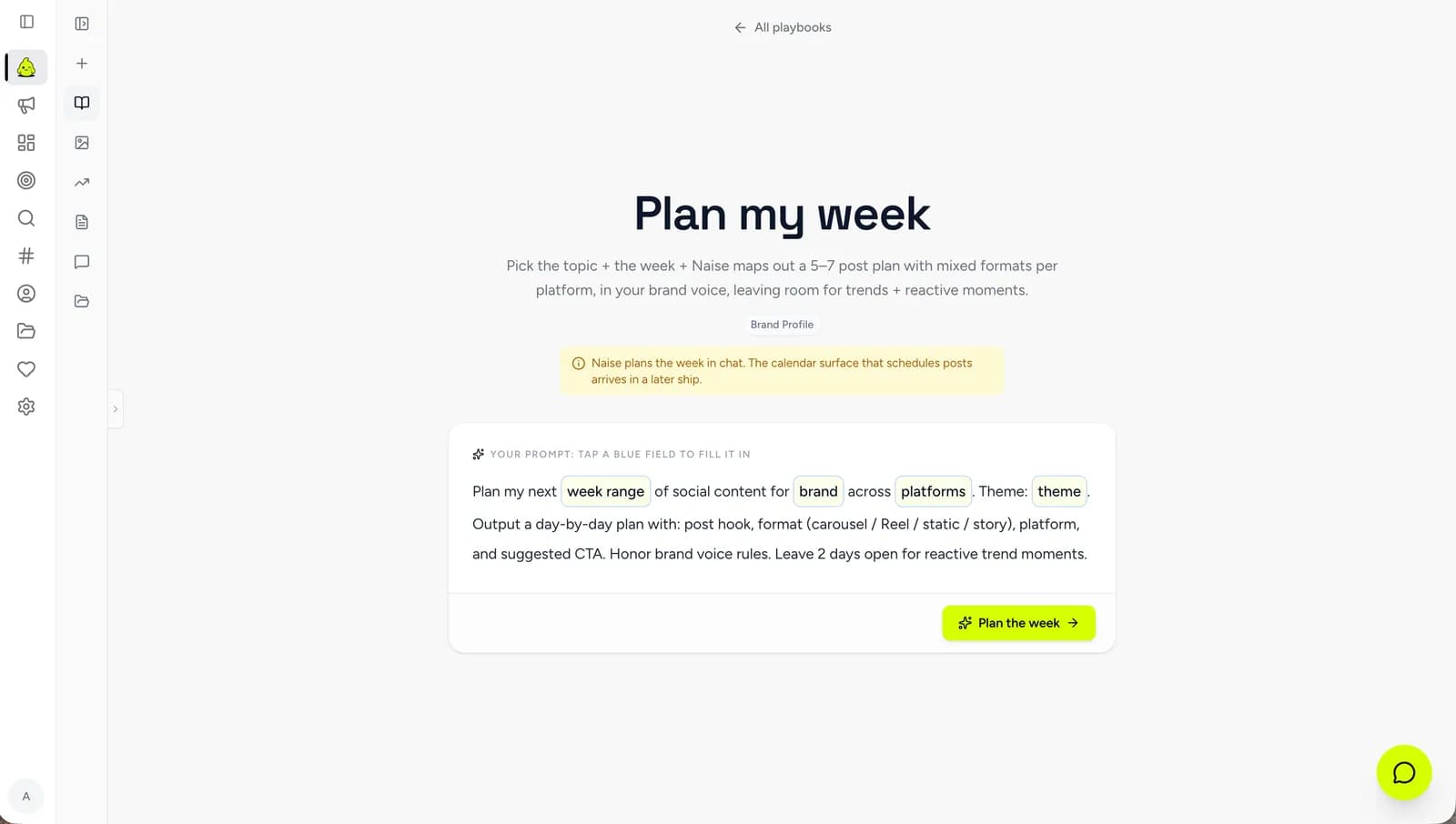
Step 3: Eliminate Blank Pages with Playbooks. To move even faster, you select one of our pre-configured Playbooks. These are expert-level prompt templates built by seasoned marketers. You just pick "Organic Spillover Capture" or "Product Story Arc", and the complex prompting is handled for you behind the scenes.
Step 4: Deploy the SMM Agent. The instructions are sent directly to the SMM Agent. This autonomous operator doesn't just write the text. It applies your exact emoji policy, generates the visual assets, and schedules the final post directly to your social channels.
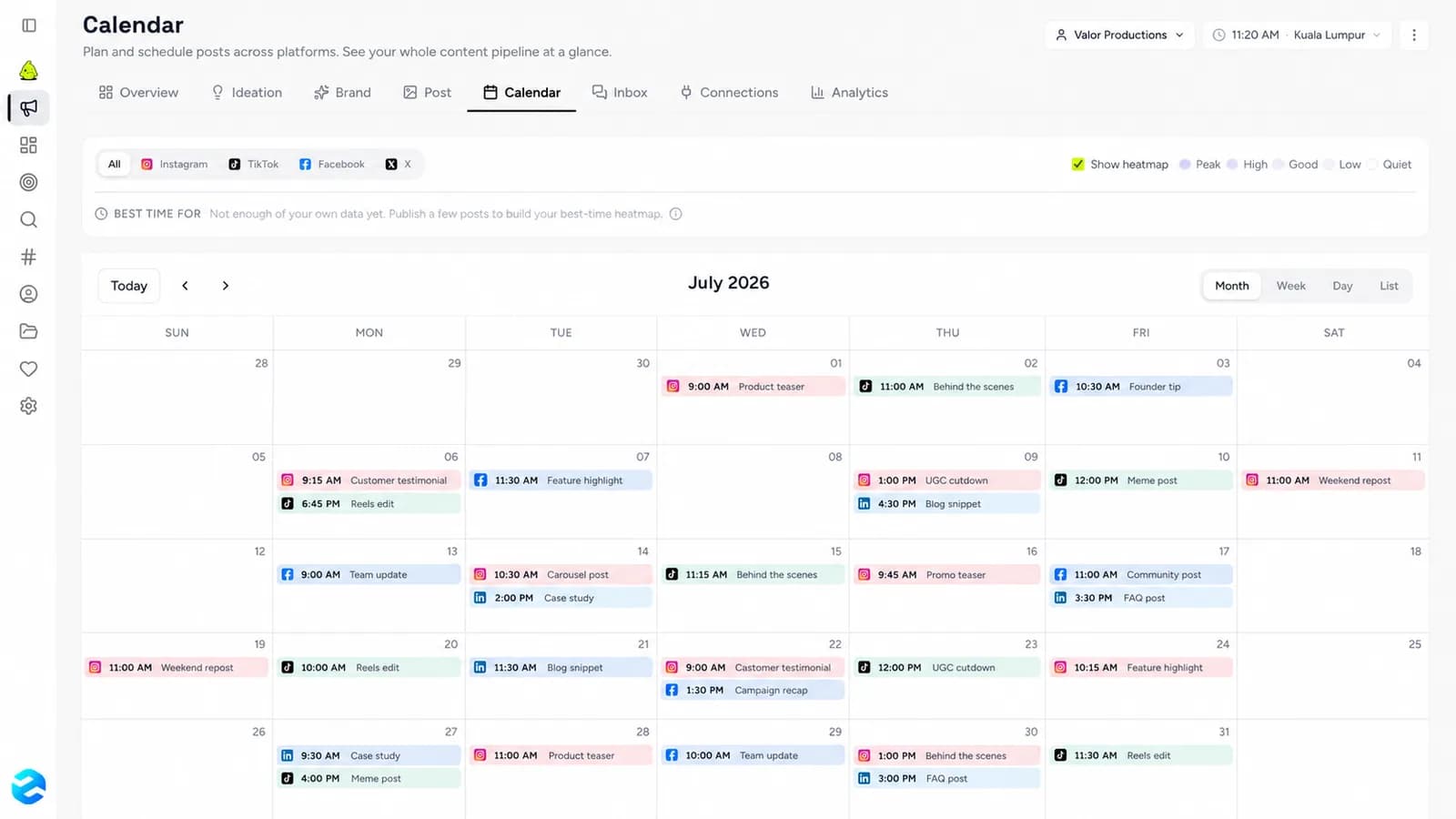
Trying to scale marketing without hiring is impossible if your team is trapped doing the manual grunt work of the past decade. By ditching the fragmented stack and moving to an integrated, autonomous ecosystem, you reclaim your most valuable asset: time. Let the AI handle the heavy lifting of scheduling and drafting. You should be focusing on the creative strategy that actually moves the needle for your business.
Are you ready to see exactly how your brand is currently performing across the web before you make your next move?
Frequently Asked Questions (FAQs)
What is the fastest way to scale organic marketing?
The fastest way to scale organic output is to eliminate manual task execution. By using automated workflows to handle drafting, image sourcing, and scheduling, a single marketer can manage multiple channels simultaneously. This allows the business to increase posting frequency without increasing headcount.
How do autonomous agents differ from standard AI writers?
Standard AI text generators only provide raw copy, leaving the marketer to manually edit, format, and publish the text across different platforms. Autonomous agents operate within an integrated ecosystem. They remember your brand context, draft the content, and execute the final task (like scheduling a post or sending a PR pitch) automatically.
Can a small team out-publish an enterprise competitor?
Yes, lean teams can absolutely compete with massive enterprises by leveraging operational efficiency. When small teams adopt all-in-one marketing ecosystems, they eliminate the bureaucratic approval delays and fragmented software costs that often slow down larger corporations. This allows them to execute campaigns significantly faster.